
Two Cities, One Machine: Holmes and Watson Debate the Soul of Artificial Intelligence
Rather than one side winning, this angle plays out as a genuine intellectual tension between Holmes and Watson — two
sherlock holmes book that discussion between sherlock and whatson · 10 min read · April 2026
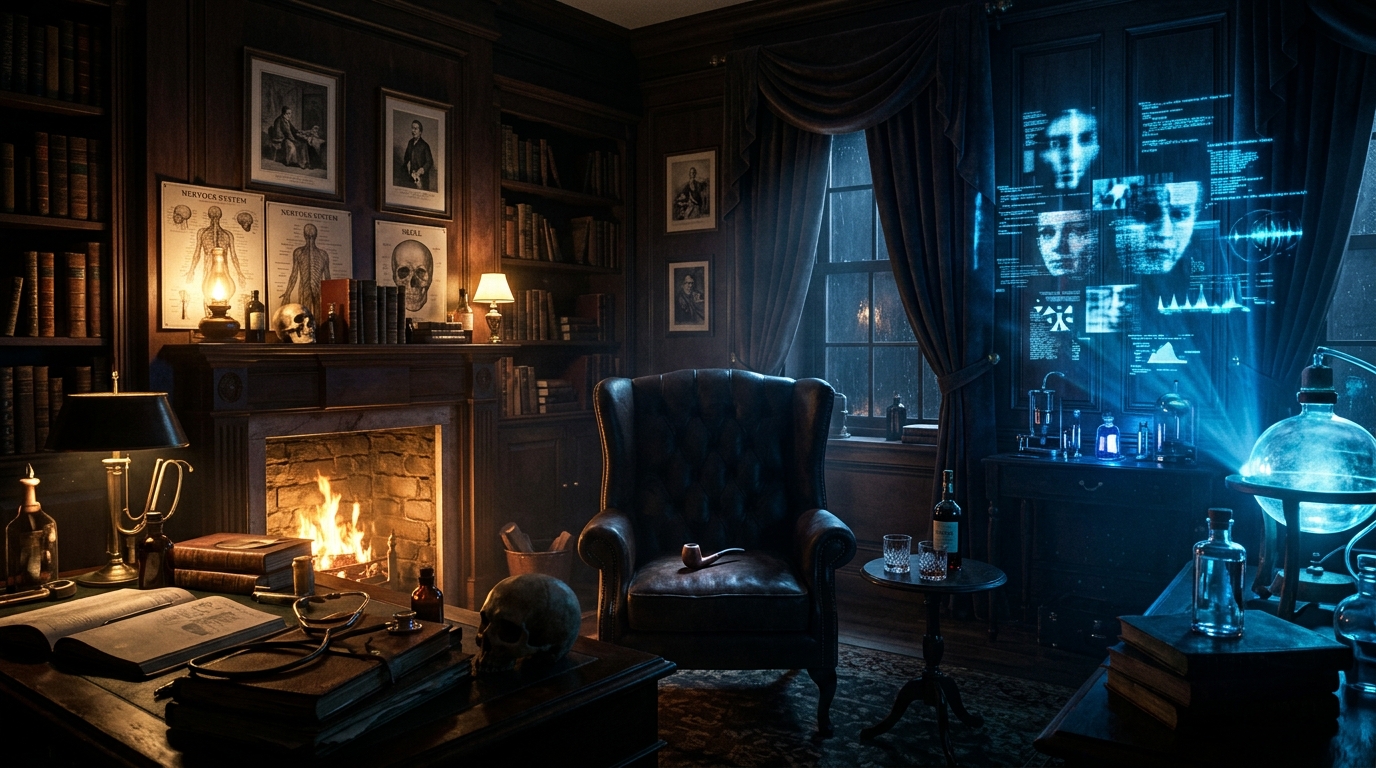
The Sitting Room at Baker Street, Sometime After Midnight
"—but that is precisely what I find so dispiriting," Watson said, setting down the newspaper with the particular weariness of a man who has argued past persuasion and into the territory of grief. "We were promised a revolution in medicine. What we received was a revolution in spectacle."
Holmes said nothing. He turned the pipe in his fingers—unlit, as it had been for an hour—and watched the fire.
Watson had spent the evening reading about the latest generative models, about the torrent of synthetic video now coursing through the internet: fabricated celebrities saying things they never said, doing things they never did, rendered in a resolution so faithful that the eye surrendered before the mind could intervene. He had come to Baker Street not for answers, but for the particular comfort of thinking aloud in the presence of someone who would not interrupt.
"I trained in surgery," Watson continued, quieter now. "I understood this technology as a diagnostic instrument—something that might catch what the human eye misses, shorten the years a family spends searching for a name for their child's suffering. And that work exists. I know it does. But the weight of public attention has drifted so thoroughly toward—what? Entertainment? Forgery? It feels as though we built a scalpel, and the world decided it preferred a kaleidoscope."
Holmes still did not speak. This was unusual. Watson had expected the familiar correction, the precise dismantling of an imprecise complaint. Instead, there was only the sound of coal settling in the grate and a silence that suggested Holmes found the question genuinely difficult.
Watson leaned forward.
"So tell me, Holmes—did we build a tool, or did we build a mirror?"
The fire offered no opinion. Holmes, at last, set down the pipe.
Watson's City: The One We Did Not Expect
Watson does not raise his voice. That is what makes his argument so difficult to dismiss.
He begins not with accusation but with memory—the promise as it was originally spoken. Artificial intelligence would compress decades of drug discovery into months. It would give diagnoses to those who had none, reading the genome as a linguist reads a sentence: fluently, structurally, with an ear for what was out of place. This was not science fiction. It was the grant proposal, the white paper, the future that serious people described to other serious people. And they meant it.
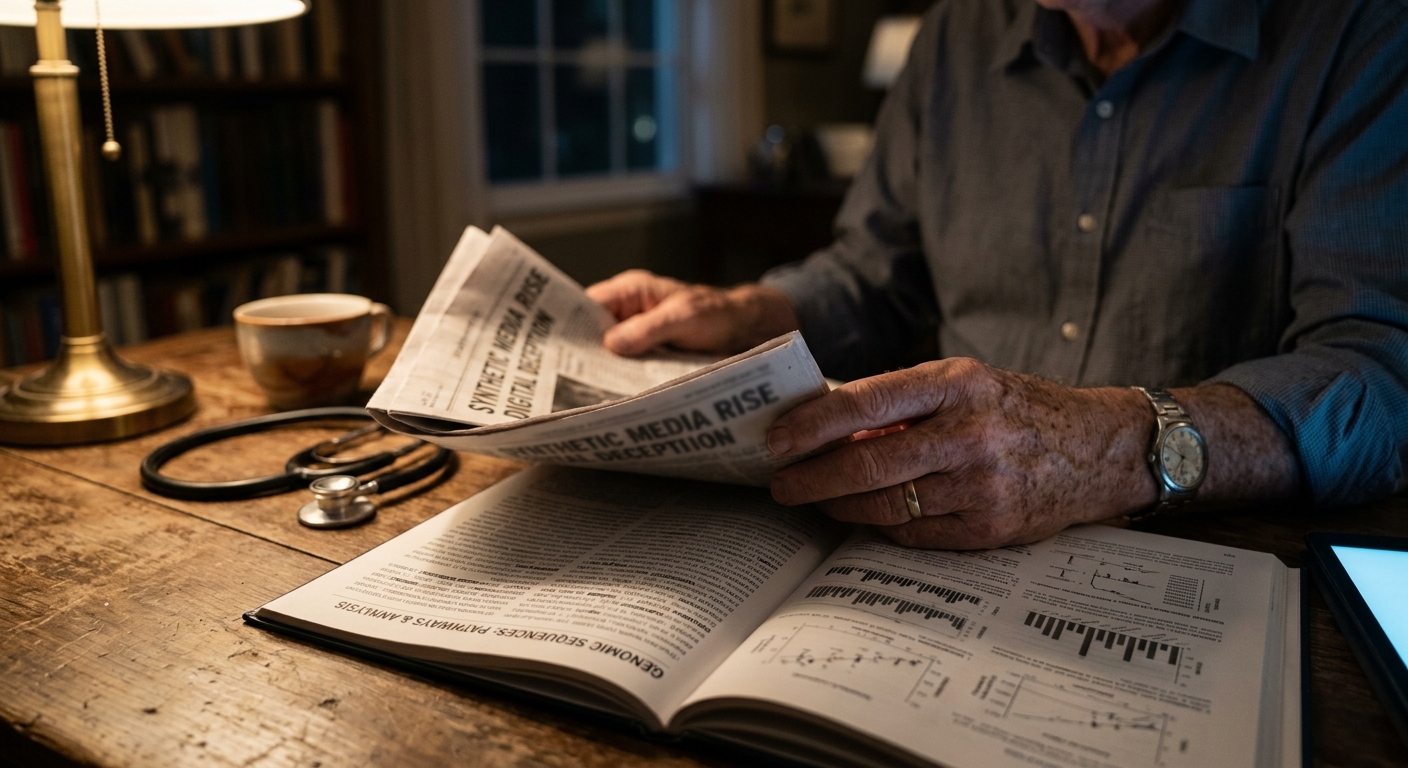
What Watson describes now is not betrayal, but something quieter: a drift. He gestures at the landscape most people encounter when they hear the letters "AI"—the viral deepfakes, the generated faces that belong to no one, the tools that simulate creativity rather than solve suffering. He is careful here. He does not wish to be mistaken for a Luddite. He is a disappointed believer, which is worse, because a disappointed believer understands precisely what was possible.
The argument he presses is structural, not moral. The sheer volume of investment, media attention, and public imagination flowing toward generative entertainment exerts a gravitational pull. Capital follows attention. Talent follows capital. When the most visible application of a technology is the production of novelty—face filters, voice clones, synthetic influencers—the entire field bends toward that center of mass. Not because anyone decided the genome mattered less, but because no one had to decide. The attention economy decided for them.
Watson's city is not dystopian. He wants that understood. There are no rogue superintelligences, no surveillance nightmares. It is merely disappointing—a place where the extraordinary was made ordinary by misallocation. He is not afraid of the technology; he is saddened by what it has become in the public imagination.
Then he lands on something specific, something that resists abstraction. A family—a real family, repeated thousands of times across the world—that has waited years for a rare disease diagnosis. A model called PopEVE can now evaluate genetic variants and produce probable diagnoses; in one study of roughly 30,000 patients with severe developmental disorders, it offered answers for about a third of them, families who had lived inside a diagnostic odyssey with no map and no endpoint (Alation).
That family exists in a different city than the one building filters for social media. Watson does not say which city is winning. He does not need to.
Holmes's City: The One That Runs Quietly
Holmes does not argue. He simply adjusts the frame.
Consider the very model you mention, he says—PopEVE. Or consider the AI-powered stethoscope developed by researchers at Imperial College London and Eko Health, a device that layers acoustic readings over ECG signals to detect cardiac abnormalities that fall below the threshold of human hearing. It is not glamorous technology. It does not generate shareable content. It sits in a clinical trial, doing what clinical trials do: moving slowly, proving things.

This is Holmes's structural argument. The beneficial city does not trend. It publishes in journals. It advances through peer review, through regulatory approval, through the painstaking accumulation of evidence that is, by design, invisible to anyone scrolling a feed. The silence around these developments is not a sign of failure; it is a feature of how science communicates—which is to say, poorly, to everyone except other scientists. Watson's despair, Holmes suggests, may be a problem of perception, shaped by the media he consumes, rather than a failure of the technology itself. The city he cannot see is not absent. It is merely quiet.
But Holmes is careful not to claim this city is winning. He does not wave PopEVE like a flag. He simply insists that it exists.
He does, however, linger on one detail. The model was deliberately designed to avoid penalizing genetic variants that appear more frequently in non-European populations—a known failure mode in genomic tools trained predominantly on European data. This was not an afterthought. It was a design choice, made early, by people thinking about whom the technology would serve before they knew if it would work. It suggests that at least some builders in this quieter city are asking the right questions, even if no one is filming them.
Whether enough of them are asking—that, Holmes concedes, is a different matter entirely.
The Question of Neutrality
Watson, however, does not take the offered comfort. He grants the examples. Yes, there are systems helping clinicians hear what they might otherwise miss. Yes, there are models like PopEVE easing the long ordeal of the rare-disease odyssey. The point, he insists, is not that these things are fictional. It is that their existence, by itself, tells us nothing about proportion.
A diagnostic model and a synthetic-video engine may both be real, but they do not move through the world with the same velocity. They are not fed by the same incentives. Capital is not a moral faculty; it is a sorting mechanism. It flows toward what captures attention, scales cheaply, and promises returns. Platform economics, more ruthlessly still, rewards what is frictionless, shareable, and habit-forming—not necessarily what is vital. Watson's objection is less about technology than about the logic of our economy: the question is not whether beneficial AI exists, but whether it is given anything like equal oxygen.
That is why he bristles at the phrase "the technology is neutral." Neutral in what sense? A hammer left on a table may be neutral. But a technical ecosystem financed, promoted, and optimized by powerful institutions is not merely lying there, awaiting moral instruction. To invoke neutrality is to risk a kind of distributed absolution: the builders say users decide; the funders say they only back demand; the platforms say they merely host what people want. Responsibility dissolves into the atmosphere.
Watson's sharpness comes from refusing that comfort. He is not anti-technology; he is anti-complacency. He does not dispute that AI can serve medicine and science. He disputes the serenity with which we note that fact while accepting an economic order that amplifies the trivial, the addictive, and the counterfeit. In a world of radically unequal resources, neutrality begins to look less like balance than surrender.
His rebuttal does not conclude so much as darken. If the tool is neutral, if the market is neutral, if the platform is neutral—then who, exactly, authored the city we have built?
The Uncomfortable Verdict
A long silence settled between them—the kind that arrives not when an argument has been won, but when both parties realize it was never quite the right one.
"You are correct," Holmes said at last, and the concession carried no defeat. "The structure is as you describe. Capital flows toward spectacle. Attention follows novelty. The diagnostic model labors in obscurity while the deepfake circulates in millions. I do not dispute the architecture of your complaint."
Watson leaned forward, sensing an opening.
"But," Holmes continued, the word hanging in the air like smoke, "you are drawing the wrong conclusion from a correct observation. You speak as though the technology has been captured—as though the frivolous application negates the serious one. It does not. It never has."
He rose and moved to the window, his back to the room.
"The question was never what the technology could do. It was always what human attention was worth. And that question, Watson, is older than either of us. It was asked of the printing press, which produced both the Principia and penny dreadfuls. It was asked of television, which broadcast the moon landing and sold cigarettes in the same hour. The technology does not choose. It has never chosen."
"Then you concede the problem," Watson said.
"I concede that the two cities are real. But they are not at war. They are parallel." Holmes turned from the window, his expression holding something Watson had not expected—not triumph, but a kind of profound weariness. "The model that shortens a child's diagnostic odyssey and the generator that fabricates a politician's voice do not cancel each other out. They coexist. And the moral weight of that coexistence falls not on the machine, but on the institutions that deploy it, the policies that govern it, the collective choices that determine which city receives the roads and which receives the neglect."
Watson opened his mouth to respond, but Holmes was not finished.
"You keep asking whether this intelligence has failed humanity or saved it. I am telling you that this is the wrong question, and that you ask it because the right question is more frightening." He paused. "The right question is not what the technology is doing. It is what you—all of you, the funders, the regulators, the public that clicks and shares and looks away—are choosing to do with the most powerful amplifier of human intention ever constructed."
The fire cracked. Neither man spoke.
"And so we are to be content?" Watson asked quietly.
"No," Holmes said. "You are to ask the question of yourselves. And I suspect you will find that answer far less comfortable."
The Third Person in the Room
Of course, Holmes and Watson have never been alone. You have been here the entire time—the silent third, for whom the argument was always staged. And now the question turns, as it was always going to, toward you.
The two cities are not a metaphor; they are a governance problem. Someone decides which AI applications receive regulatory scrutiny and which glide through unexamined. Someone allocates public funding. Someone determines what surfaces in a feed, what reaches the next hundred million users. These are not neutral decisions, and they are not made by machines. They are made by legislators, investors, and product managers responding to what they believe people want. Which brings us back to you.
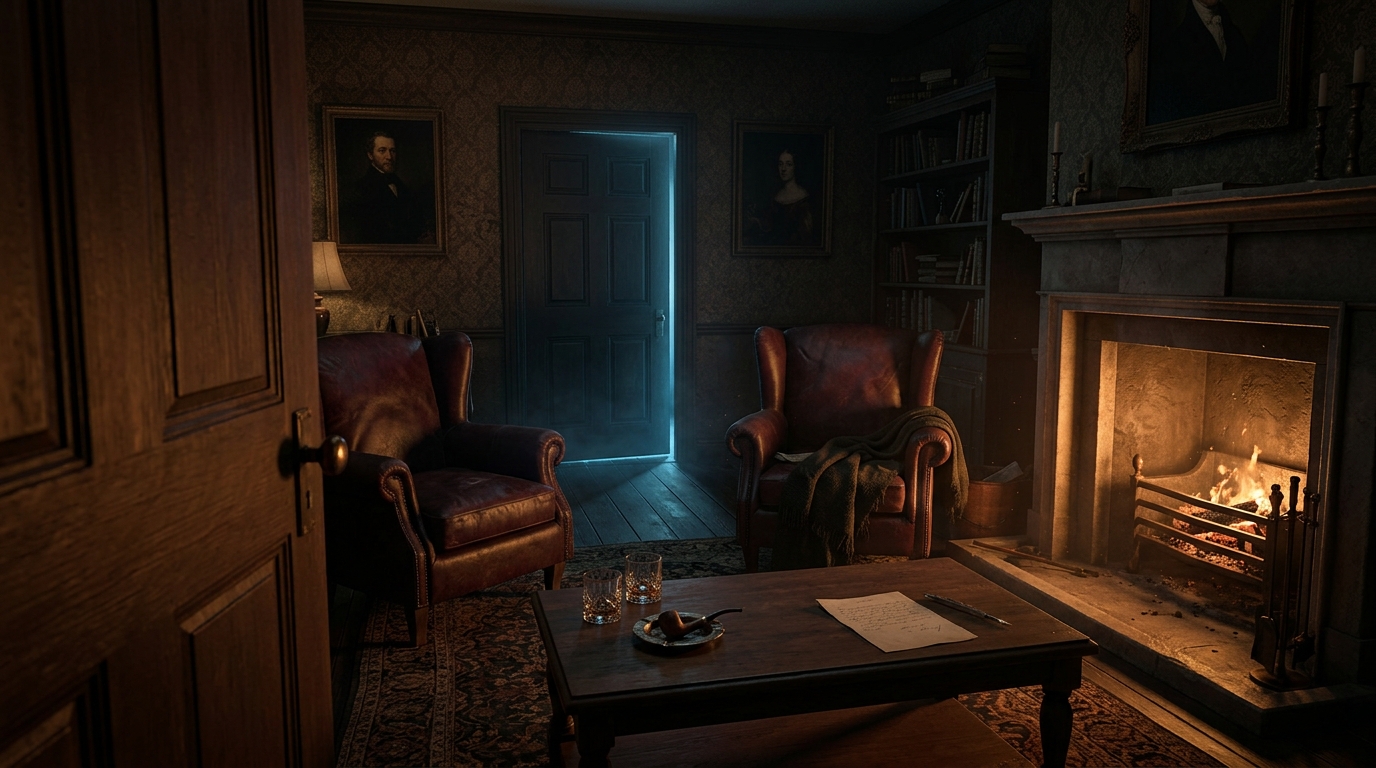
Our attention is not innocent. Every hour spent with a generated image, every click on a deepfake exposé rather than a story about a diagnostic breakthrough—these are micro-allocations. Individually trivial. Collectively, they are the atmosphere in which Watson's grief becomes structurally rational. The market for wonder is not rigged. It is simply answered, daily, by millions of people who do not think of themselves as answering anything at all.
It would be easy, here, to prescribe a solution. To say: pay attention differently. But that would be a clean exit from a room that deserves to stay uncomfortable. The harder truth is the one neither Holmes nor Watson can resolve: if the machine is genuinely an amplifier, then the entire moral weight falls on human choices. Not on the technology. On the wanting. And that burden is heavier, not lighter, than blaming the tool—because it cannot be patched, regulated, or retrained.
It can only be carried.
And so they returned, not to a conclusion, but to their chairs.
Watson, still unconvinced, could not relinquish the family at the center of the question—the one waiting for an answer that a system like PopEVE might deliver. Holmes, no less aware of that mercy, refused the comfort of letting one good use obscure the whole. The same machine that can sort a genetic variant against the long ledger of evolution can also be turned toward ends too trivial, or too sordid, to deserve its power. That is not a contradiction. It is the condition.
So they sat with the asymmetry. Watson thinking of one household suspended between fear and reprieve; Holmes thinking of that household, too, and of thousands of others, elsewhere, doing something utterly different with the same apparatus. Two cities, still standing. One machine, still indifferent. The question was never whether it works, but whether we would prove worthy of it.