
The Case of the Vanishing Triangle: Sherlock Holmes Solves the Bermuda Mystery
Sherlock Holmes and Dr.
hook, intresting, sherlock holmes and watson discussion · 12 min read · April 2026
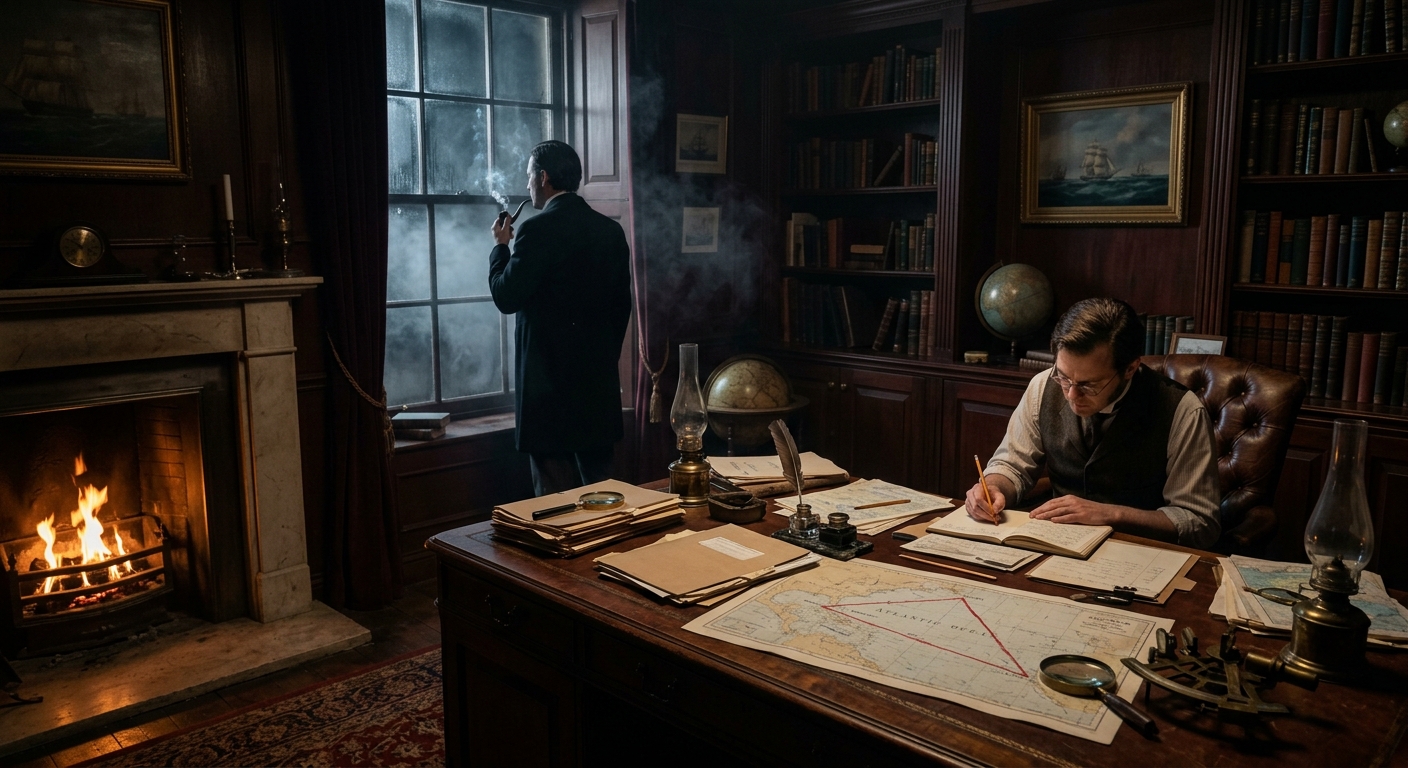
A Most Peculiar Cold Case Arrives at Baker Street
The dossier sat atop a precarious geology of newspapers, tobacco pouches, and what appeared to be a dissected barometer—fat, manila, and labeled in block capitals: THE BERMUDA TRIANGLE. I had not been in Baker Street five minutes before I was reaching for it.
"Careful, Watson." Holmes did not look up from the window. "You'll disturb my filing system."
"You have no filing system."
"Precisely why disturbing it is so easy." He turned then, and I recognised the particular light in his eyes—not the feverish gleam of a man chasing a criminal, but the cooler, more dangerous brightness of a man who has spotted an impostor. "What do you know of the Triangle?"
I confessed I knew what everyone knows: ships swallowed whole, aircraft vanished mid-transmission, compasses spinning like tops. Supernatural forces, some said. I may have used the word inexplicable with rather more conviction than I intended.
Holmes's expression was briefly, exquisitely pained. "A case built on fog, not facts," he said. "Which is, of course, precisely why it deserves our attention. Myths this stubborn are never accidents."
He crossed to the desk and jabbed a finger at a map. "The region in question: a rough triangle connecting Miami, the island of Bermuda, and Puerto Rico. Perhaps 500,000 square miles of Atlantic Ocean. No official maritime boundary, no governing body, no formal designation—just a name that has somehow convinced the world it is a place where physics takes a holiday."
"And yet you've opened a file."
"I've opened a case." He settled into his chair with the satisfaction of a man already three moves ahead. "Sit down, Watson. Take out your notebook. We follow the evidence—clue by clue, legend by legend—until the fog lifts."
I uncapped my pen. The game, as ever, was afoot.
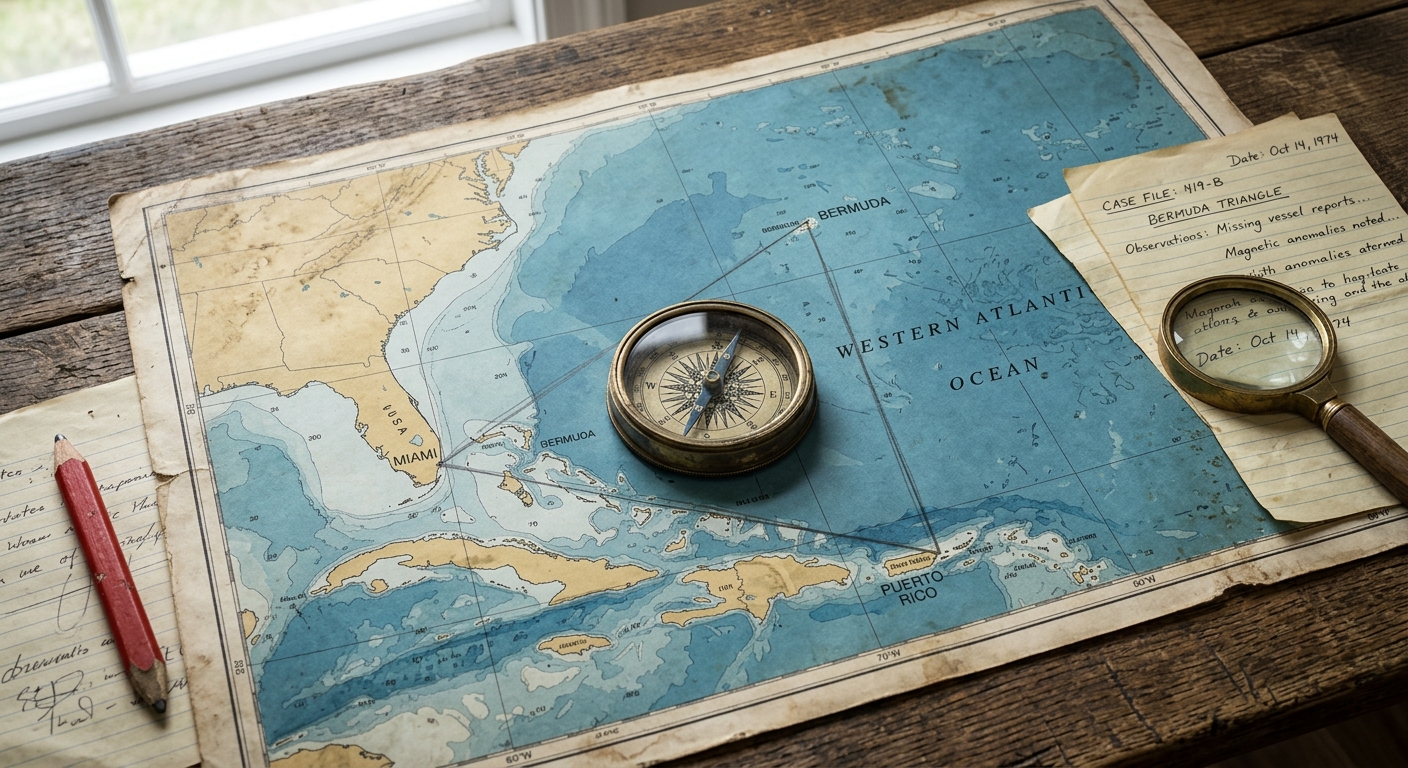
"First," said Holmes, with that particular brightness which meant some cherished illusion was about to be strangled with its own ribbon, "we must address the most efficient conjuring trick in the whole affair: the invention of the thing itself."
"You mean the Triangle?" I asked. "Surely the region existed before people wrote about it."
"My dear Watson, the sea existed. The brand came later." He steepled his fingers. "What the public now calls the Bermuda Triangle was not handed down by Neptune on a stone tablet. It was assembled, named, and merchandised. Vincent Gaddis coined the phrase in a 1964 magazine piece; Charles Berlitz then turned it into a global sensation with his 1974 bestseller. A patch of ocean became, by the oldest magic in publishing, intellectual property."
I confess I felt a little foolish. "So the mystery was, at least in part, packaged?"
"Packaged, polished, and sold," said Holmes. "You are surprised only because the trick succeeded. The most durable myths are not discovered; they are edited." He rose and paced once before the fire. "Observe the mechanism. A ship vanishes, an aircraft goes missing, a tale is retold. Thousands of vessels pass through the same waters without incident, and no one writes sonnets to their punctual arrival. The human mind is a deplorably selective archivist. It preserves the dramatic and mislays the ordinary. That, Watson, is confirmation bias in evening dress."
"And once the label exists," I said, warming to it, "every new mishap is pinned to it like another exhibit."
"Precisely. A name creates a net, and every loose fact is dragged into it." He stopped, smiling with almost indecent satisfaction. "But the decisive point is not literary. It is commercial. If this region truly possessed the murderous statistical appetite attributed to it, the first men to notice would not be occultists or paperback prophets, but insurers. Lloyd's of London—that cold-eyed parliament of risk—does not charge higher premiums for ships crossing the so-called Triangle. I consider that the single most damning fact in the case."
I could not help laughing. "So the legend survives where the ledger refuses to."
"Exactly," said Holmes. "And once one sees that, the remaining marvels begin to look less like evidence than advertising."
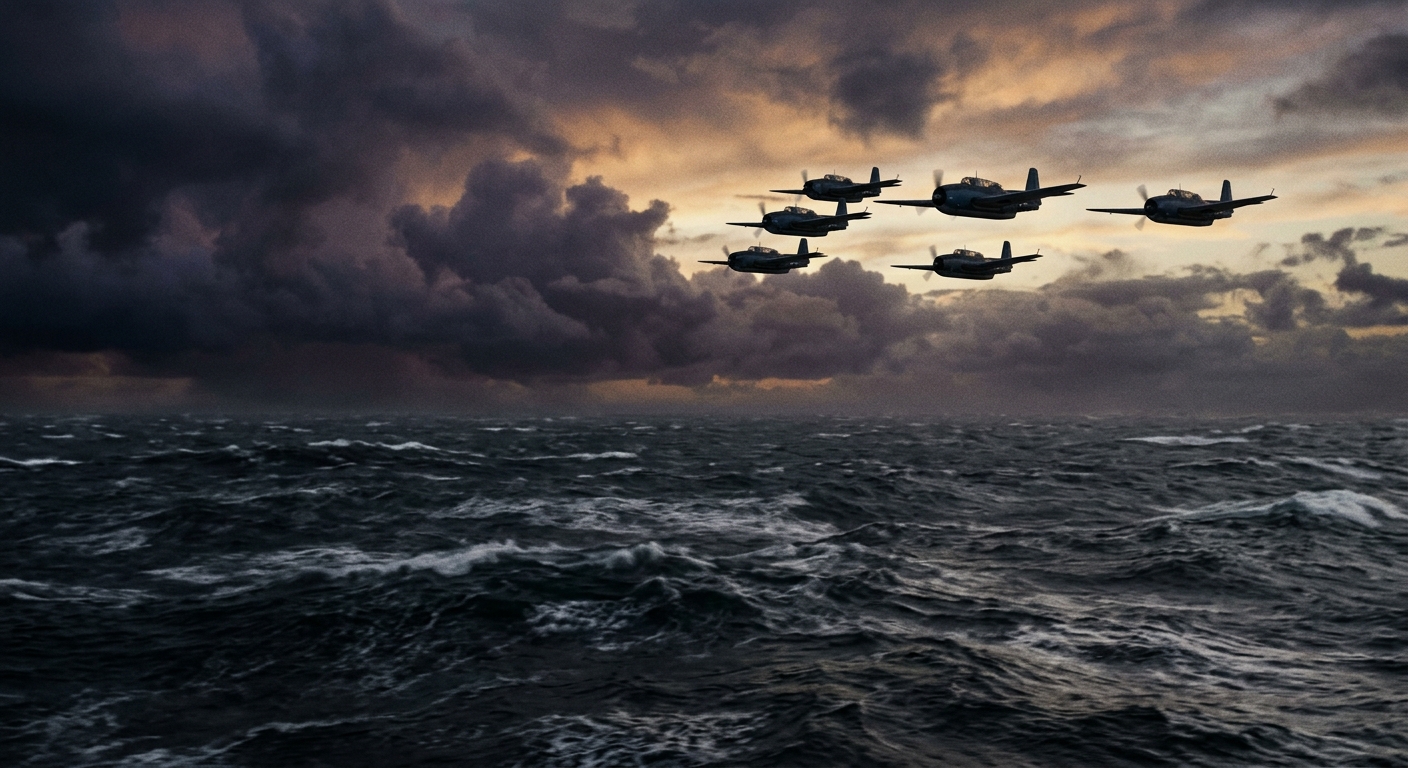
"Then let us examine the prize exhibit," I ventured. "Flight 19. The five Navy bombers that vanished in December 1945. If ever there were a jewel in the Triangle's crown—"
"Paste, my dear Watson," Holmes cut in. "Polished paste."
He sketched the affair with infuriating calm: five U.S. Navy TBM Avenger torpedo bombers on a routine training flight, fourteen men, and then confusion thickening over the Atlantic like dusk itself. "The enchantment," Holmes went on, "lies not in what happened, but in how badly it has been retold."
The lead pilot, he explained, became disoriented after his compasses failed and he mistook his position. The radio traffic, far from being an occult whisper from the abyss, was contradictory in the most human way: uncertainty, disagreement, men trying to reconcile instruments with weather and fading daylight. "One hears in such exchanges," Holmes said, "not the voice of the supernatural, but the sound of a bad situation becoming worse by increments."
I frowned. "Yet they disappeared entirely."
"In the Atlantic, at night, in deteriorating weather, after flying the wrong way. 'Entirely' is what the sea does best." Holmes's central point was devastating in its simplicity. Once the leader concluded they were over the Florida Keys, the fatal logic followed: he kept the formation out over open water when a turn in the opposite direction might have brought them toward land. Fuel dwindled. Darkness closed. The ocean, which requires no mythology to be lethal, did the rest.
"And the rescue plane?" I pressed. "Surely you will not dismiss that too. It vanished shortly after takeoff."
"I do not dismiss it," said Holmes. "I explain it." The PBM Mariner sent to search for Flight 19 had a grim reputation as a volatile aircraft, and witnesses aboard a nearby tanker reported a fireball not long after it departed. "A machine may be tragic without being supernatural."
I was quiet a moment. "But Holmes—fourteen men."
"Yes," he said, more gently. "That is precisely why one must resist embroidery. Grief invites legend; evidence demands discipline. The case of Flight 19 is sad enough without asking ghosts to navigate it."
"That is a recent tragedy," I noted, turning a page in my notebook. "What of the older ones? The USS Cyclops—a 542-foot Navy collier, gone in March 1918 with 309 souls aboard. No distress signal. No wreckage. If one wished to manufacture a maritime ghost story, one could hardly improve the ingredients."
Holmes steepled his fingers. "Quite. And this, Watson, is the hardest case in the file. One must have the decency to admit when the evidence arrives in rags. Certainty is a luxury; honesty is a duty."
"That is not as dramatic as I hoped."
"No," said Holmes, "which is why it is usually true." He rose and paced once. "What do we have that deserves belief? First, the Cyclops was burdened with manganese ore—dense cargo, and by every sensible account a dangerous one if improperly distributed. Second, the vessel had a known mechanical weakness: one engine was not in proper condition, which matters rather a lot when a large ship must keep her heading in ugly seas. Third, she sailed into the Atlantic in late winter, when storms require no assistance from the supernatural."
I frowned. "Yet no wireless call at all? Not even a final cry?"
"Which," said Holmes, "argues less for mystery than for suddenness. A ship in prolonged distress may signal. A ship that suffers catastrophic structural failure may do nothing of the kind. If the hull buckles, if cargo shifts, if heavy weather catches a compromised vessel at precisely the wrong moment, the interval between trouble and oblivion can be measured in minutes."
"And the missing wreckage?"
Holmes gave the smallest shrug. "My dear fellow, this was 1918, not an age of satellites and instant search grids. The open Atlantic is not a drawing room carpet upon which one notices a dropped cufflink. It is an enormous machine for scattering, swallowing, and refusing to explain itself. The absence of wreckage is not, in itself, a riddle. It is simply the ocean doing what oceans do."
I nodded slowly. "So the silence of the Cyclops may be terrible—but not miraculous."
"Precisely," said Holmes. "And once one has cleared away the miracle, the rest of the Triangle begins to look much less enchanted."
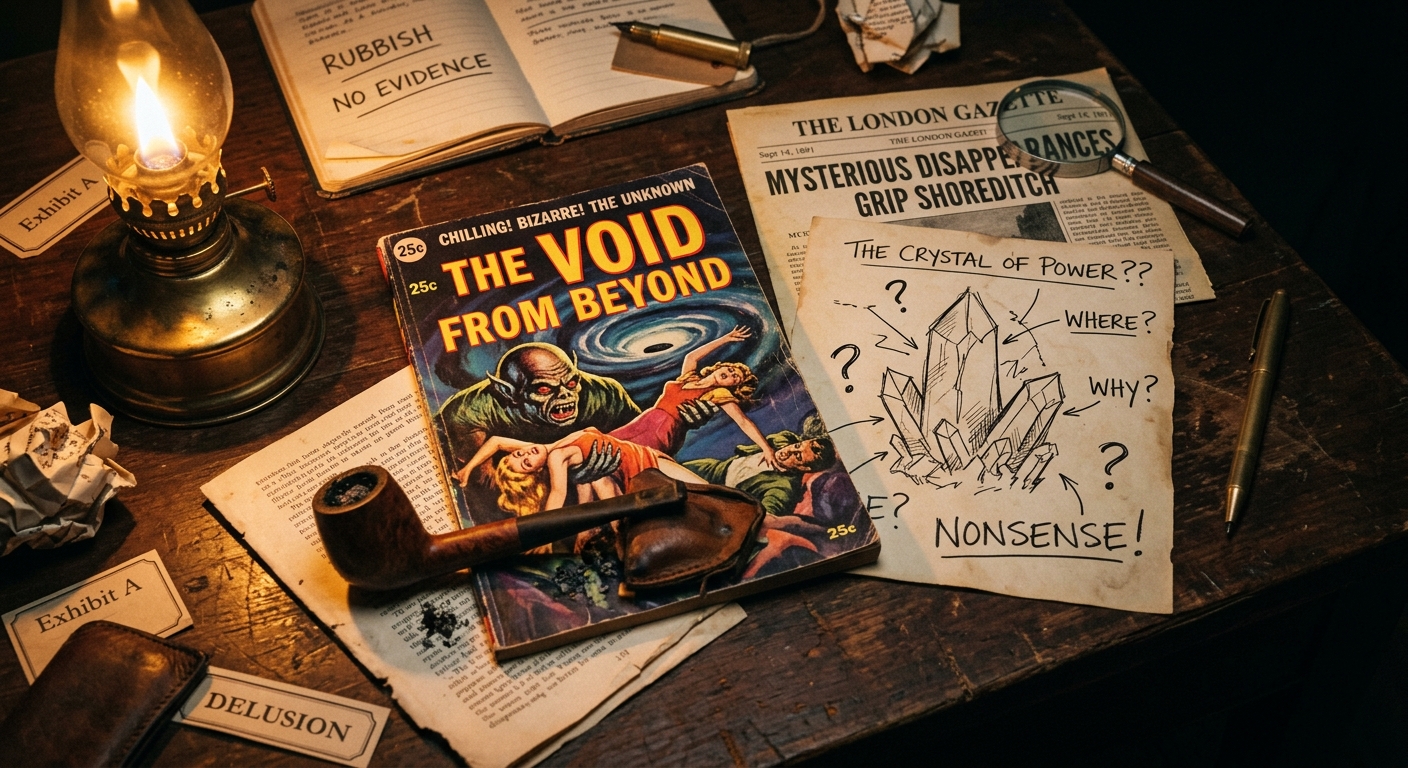
"And yet, Holmes," I began, picking up a garishly coloured paperback from the evidence table, "one cannot ignore the sheer volume of speculation. The public imagination demands a culprit more compelling than simple human error." I cleared my throat, feeling a blush rise. "First, abduction by extraterrestrials."
Holmes did not look up from tamping the tobacco in his pipe. "An interstellar civilization, Watson, that crosses the void between stars only to snatch a few cargo ships and training planes? It is the logic of a man who owns a diamond mine yet insists on stealing pebbles from a garden path. Absurd."
I flipped a page, my voice dropping. "Very well. What of a powerful energy crystal, malfunctioning within the sunken ruins of Atlantis?"
"A city that mastered cosmic energies but neglected to invent the fuse box," he murmured, striking a match. "Continue. This is more amusing than the morning's crossword."
Feeling my dignity evaporate, I pressed on. "A time warp! Or perhaps 'Unidentified Submerged Objects'—USOs—patrolling a secret underwater base!"
A plume of smoke was my only initial reply. "If time were so porous in that stretch of ocean, we should expect our fishing trawlers to occasionally haul up a bewildered trireme. As for secret bases, the world's navies possess sonar that can detect a school of herring passing gas. I suspect a hidden metropolis would not have escaped their notice."
I finally found a theory that sounded vaguely scientific. "Here is something more plausible: methane hydrates. Eruptions of gas from the seabed that lower the water's density..."
"And swallow a ship whole. Yes, it is a chemically sound principle," Holmes conceded, finally glancing up. "It is also a theory entirely bereft of evidence. There are no geological signs of such a cataclysmic gas release coinciding with any of the famous disappearances." He gestured with his pipe stem. "Much like the claims of magnetic anomalies. The 'Devil's Triangle' is not, in fact, a place of unusual compass deviation. True magnetic anomalies exist, but this region is not one of them. It is a fiction that makes for a better story."
I set the book down, a laugh escaping me at last. "So, no aliens, no Atlantis, no time-bending sea monsters."
"My dear fellow," Holmes said, a glint in his eye. "The truth is, as it so often is, infinitely more simple and, to the mundane mind, infinitely more disappointing."
"Then you will tell me there is nothing there at all," I concluded.
"My dear fellow, that is the last refuge of a lazy mind," said Holmes. "The error is not in noticing danger, but in dressing danger for the theatre."
He tapped the chart. "This region is no enchanted triangle. It is, however, an admirably efficient machine for mischief. Consider first the Gulf Stream—one of the Atlantic's great moving forces, and what I might call the ocean's own evidence-disposal service. If wreckage goes overboard here, the sea does not preserve the scene for the convenience of later storytellers. It seizes, scatters, and carries it off."
"And the weather?" I asked. "People do speak of storms arriving as if summoned."
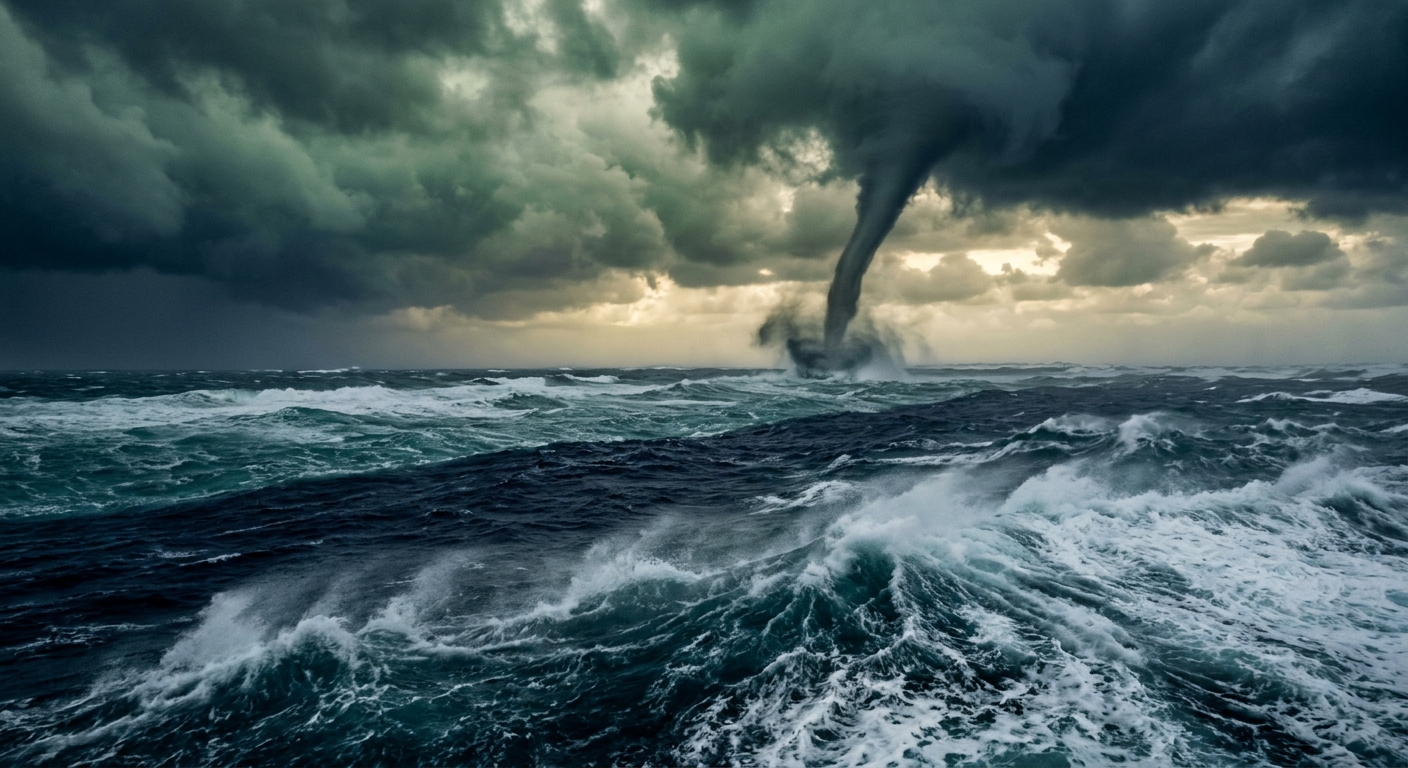
"Because weather in the Caribbean and western Atlantic can turn murderous with indecent speed," said Holmes. "Waterspouts, microbursts, tropical squalls—call them what you please. A small vessel or aircraft does not require a curse to be overwhelmed; it requires only a few bad minutes and a pilot who has mistaken routine for safety."
He leaned back with that air of a man who has found the obvious and is faintly disappointed that others have not. "Add to this the simplest arithmetic in the world: the area is heavily traveled. Busy shipping lanes, busy air routes, endless recreational traffic. Where there are more ships and aircraft, there will be more accidents. The public, however, has a touching preference for melodrama over denominators."
"So the mystery," I said, "is not wholly false—only badly interpreted?"
"Precisely. A genuinely hazardous stretch of ocean, plus immense traffic, plus the human appetite for patterns, produces a legend. Men count the striking cases, ignore the ordinary ones, and call the result a riddle. There is no need for Atlantis, aliens, or any other imported nonsense. Statistics and psychology, Watson—those are the true phantoms of the Triangle."
"So," I said, setting down my glass. "Is it dangerous or not?"
"That depends entirely on whether you count." Holmes steepled his fingers. "As we have discussed, Lloyd's of London has found no actuarial justification for charging higher insurance premiums on vessels crossing the Triangle. The U.S. Coast Guard, having reviewed decades of incident reports, reached the same unremarkable conclusion: disappearance rates there are consistent with other heavily trafficked ocean regions of comparable size and weather volatility. The Atlantic is a large and indifferent body of water. It sinks ships everywhere."
"Then why does everyone believe it?"
"Because no one writes a book called My Uneventful Crossing." Holmes permitted himself a thin smile. "Dramatic losses get named, retold, and eventually embellished. Routine voyages simply arrive. That asymmetry—survivorship bias in nautical clothing—is the entire engine of the legend. And the authors who stoked it were not always scrupulous. Several vessels cited in early Bermuda Triangle literature were subsequently found to have sunk nowhere near the Triangle at all. The geography was retrofitted to the narrative."
I looked faintly embarrassed on behalf of humanity. "So we invented it."
"We curated it. Which is worse, because it required effort." Holmes rose, moving toward the window. "The genuine story—human error, violent seas, the catastrophic indifference of weather—is more unsettling than any alien hypothesis, because it carries no comfort. Mystery, at least, implies an answer waiting somewhere. Reality does not extend that courtesy."
He turned back. "The Bermuda Triangle is not a mystery, Watson. It is a mirror."
I closed my notebook with the soft finality of a verdict. The fire had burned low. Holmes sat motionless in his armchair, fingertips pressed together, pipe cooling in his hand—the posture of a man who has already moved on to the next problem while the rest of the room catches up.
"It feels rather a shame," I admitted. "People wanted it to be something."
"People always want it to be something," Holmes said, without turning from the fire. "That is precisely the difficulty. A vanished aircraft, a lost ship—these are tragedies. Real ones. They belong to real people. The moment we dress them in mythology, we stop asking the honest questions that might actually prevent the next one."
I considered this. The world was, undeniably, slightly smaller than it had been that morning. But perhaps that was the honest bargain: less magic, more truth—and the truth, at least, could be acted upon.
"The ocean doesn't require our invention," Holmes added. "It is already one of the most violent, complex, and humbling forces on this planet. Respect it for what it is, not for what a paperback novelist decided it should be in 1974."
A pause settled between us.
"Holmes," I said, "have you ever actually been to the Bermuda Triangle?"
He picked up his pipe and examined it with great interest.
"The weather," he said, "was entirely unremarkable."