
Earth: The Alien Planet We Already Live On
Reframes Earth itself as a strange, poorly understood world by cataloguing its unsolved geological, oceanic, and
informative · 9 min read · April 2026
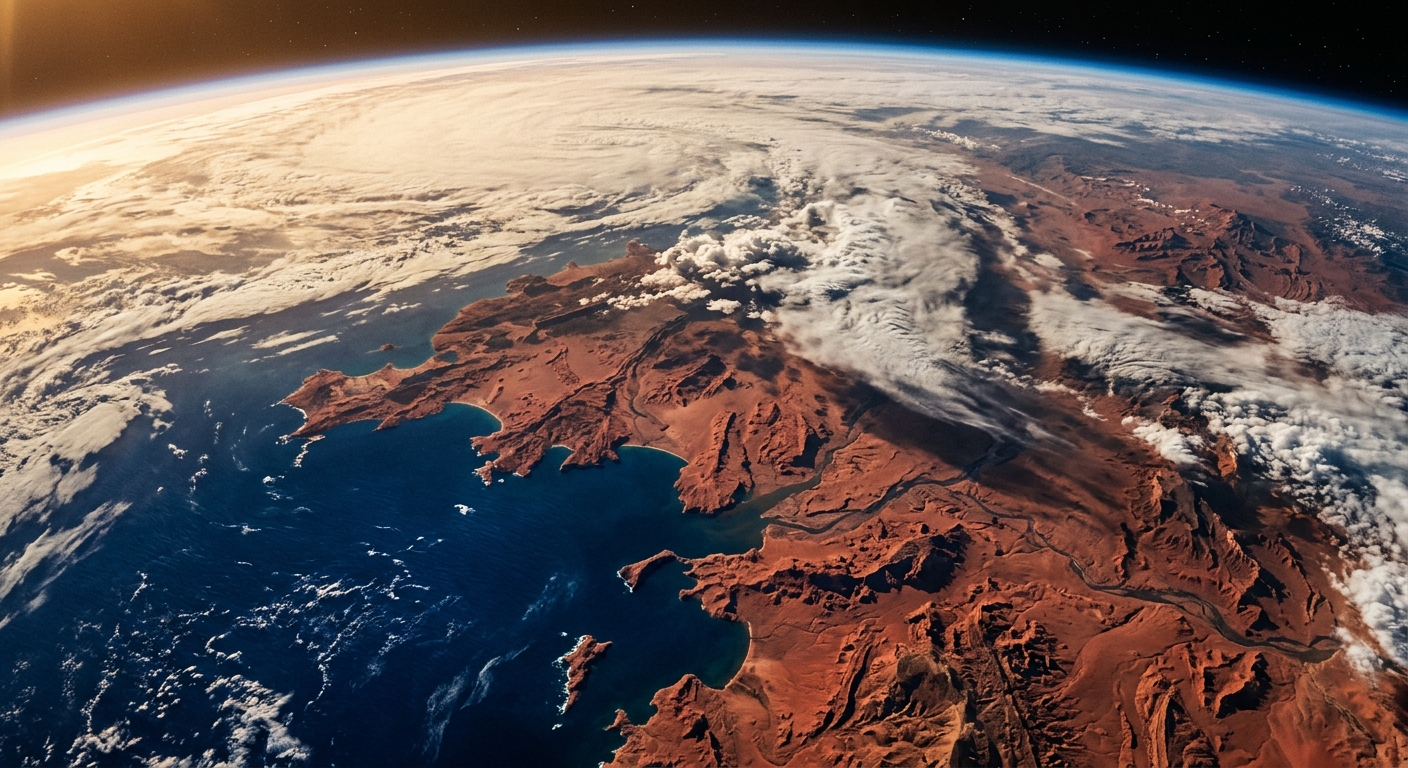
Transmission from an Unknown World
Imagine the report landing on your desk. A rocky planet, third from its star, with nearly three-quarters of its surface drowned beneath saltwater oceans. Tectonic plates grind across its face like slow-motion puzzle pieces. Off one western coast, a lake glows bubblegum pink for reasons its biologists are still debating. In a desert so vast it could swallow a continent, a 28-mile-wide set of concentric rings stares up from the sand like a giant eye—and no one can say for certain how it got there. Beneath the thin crust its inhabitants walk on, a molten interior churns at temperatures rivaling the surface of its own star.
The planet, of course, is ours.
And here's the twist. We are spending billions to aim telescopes at worlds light-years away, hunting for atmospheres, water signatures, and signs of life—yet the ground beneath our feet still holds secrets we cannot fully explain. This isn't a complaint. The impulse to scan distant stars and the impulse to drill into our own seafloor spring from the same restless hunger: What else is out there? What else is down here? Space exploration and Earth science are not rivals. They are two arms of the same reach into the unknown.
But before we keep searching the sky, it's worth pausing to ask: what if the most alien world we could explore is the one we already live on?
The Giant Eye Staring Up from the Desert
Somewhere in the western Sahara, the desert is staring back at you.
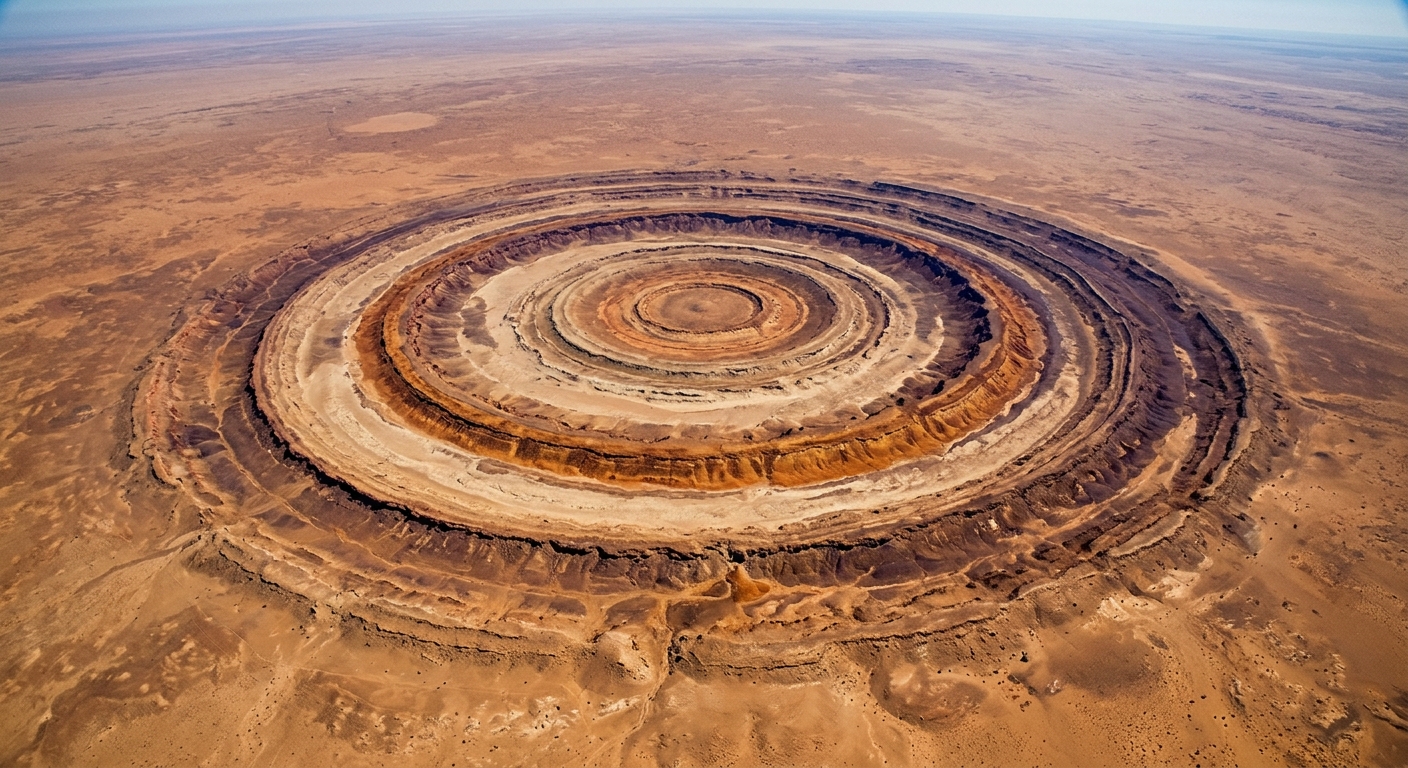
From orbit, it's unmistakable: a massive bull's-eye of concentric rings carved into the flat brown emptiness of Mauritania, so perfectly geometric it looks designed. The Richat Structure—better known as the Eye of the Sahara—stretches roughly 28 miles across, wide enough to swallow a major city. Astronauts use it as a landmark. And for decades, nobody could explain what it was.
The first guess was obvious: an asteroid impact. That would explain the circular shape, the sheer scale. But when geologists went looking for the telltale signatures—shocked quartz, melted rock, the thermal fingerprints of a cosmic collision—they came up short. Not enough evidence. Dead end.
So, maybe a volcano? Some colossal eruption that punched upward and left these rings behind? Also no. There's no volcanic rock to support it. Another dead end.
What scientists currently think happened is stranger than either guess. Around 100 million years ago, as the supercontinent Pangaea was tearing itself apart, tectonic forces pushed a massive dome of rock upward from deep within the crust. How deep? Some of the rocks now sitting at the surface may have originated 125 miles below—material from Earth's mantle, shoved skyward and then slowly exposed over eons as wind and water eroded the softer layers away, ring by ring, like peeling an onion the size of a county.
And yes, someone was going to say it: the thing does look suspiciously like Plato's description of Atlantis. Concentric rings? Check. Located past the Pillars of Hercules? Technically, check. A few enthusiastic YouTube channels have run with this theory at full sprint. Is it scientifically credible? Not remotely. But you can't entirely blame people for wondering. Look at it. The structure is so uncanny that even trained geologists had to cycle through multiple wrong answers before landing on something plausible.
If a rover on Mars photographed a 28-mile-wide set of concentric rings, it would dominate headlines for a decade. We'd fund entire missions just to understand it. But because it's on Earth—just sitting there in Mauritania—most people have never even heard of it. It's a reminder that some of this planet's biggest secrets aren't buried deep; they're just waiting in places we haven't looked closely enough.
The Lake That Forgot to Be Blue
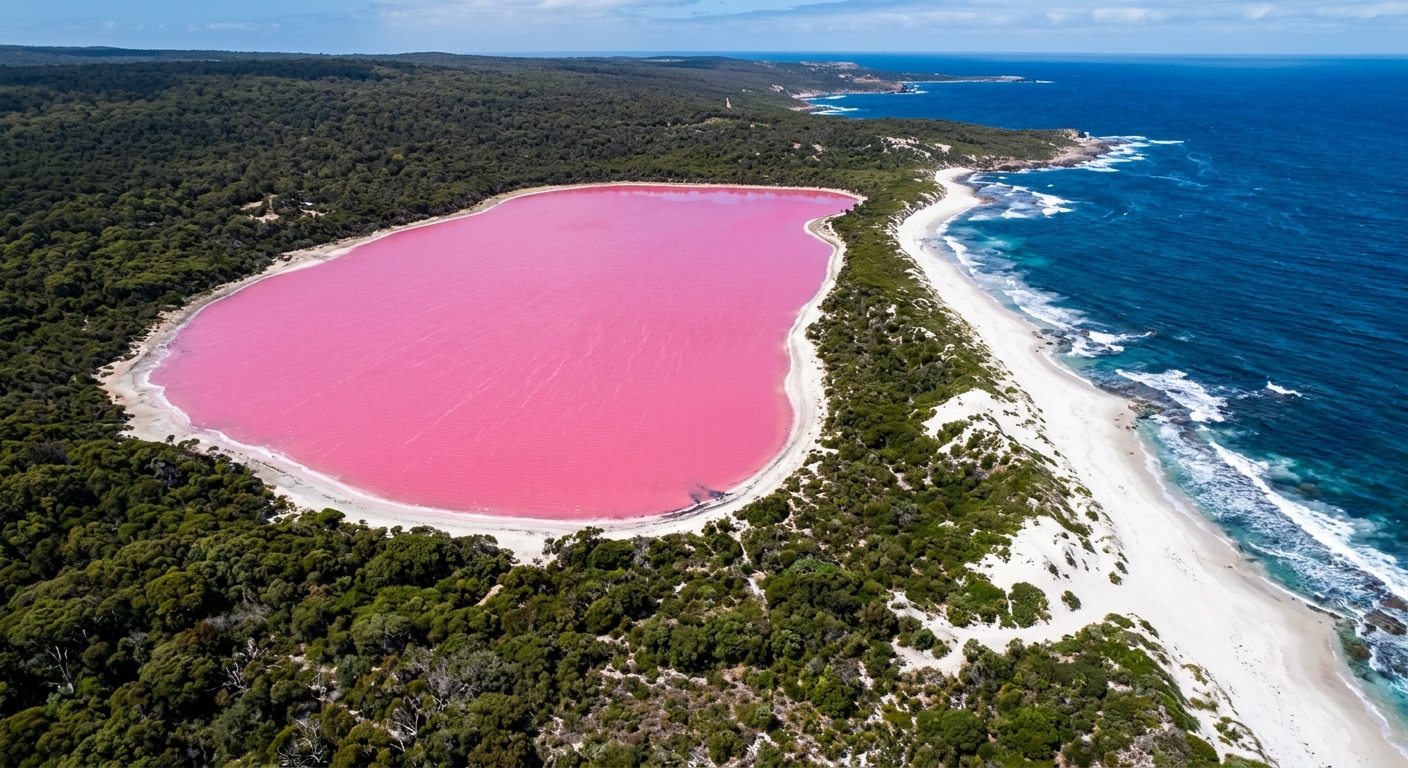
Now, let's zoom in—way in—from the Sahara's orbital-scale bullseye to a tiny island off the southern coast of Western Australia. Middle Island sits where the land finally surrenders to the Southern Ocean, and nestled in its eucalyptus-fringed interior is something that looks like a rendering error in reality's source code.
Lake Hillier is pink. Not "sort of salmon in the right light" pink. Bubblegum pink. About one-third of a mile long, it sits just inland from the coast. From the air, you get the full, absurd contrast: a bright, opaque rose pool separated by a thin ribbon of sand and vegetation from the deep, moody blue of the ocean. It looks like someone spilled a cosmic smoothie on an otherwise respectable coastline.
Here's what makes it genuinely strange. Plenty of lakes around the world blush pink under certain conditions, but Lake Hillier apparently didn't get that memo. Its color holds steady regardless of sunlight or temperature, which strongly suggests the cause isn't some trick of light. It's alive.
The leading suspects are a team of microscopic artists: a type of algae that produces red pigments to survive in the super-salty water, working alongside a salt-loving bacterium with its own vivid color palette. Together, they likely stain the entire water column pink from within. But even this explanation isn't fully nailed down; the precise biological recipe remains an open question.
Pause and consider: if a probe skimming Europa's ice cracks sent back images of a persistently pink body of liquid, the scientific community would erupt. We'd call it extraordinary evidence of alien biology. Yet here it is on Earth, painted by life so small you'd need a microscope to see it.
Life on this planet doesn't just survive. It decorates. And if it can do this on the surface, imagine the secrets churning in the world we can't see at all—the one right under our feet.
A World We've Never Seen
Here's something worth sitting with: we have flung a spacecraft past the edge of our solar system. Voyager 1 is more than 15 billion miles from home, still transmitting. And yet, beneath our own feet, we have barely gone anywhere at all.
The deepest humans have ever drilled is the Kola Superdeep Borehole in northwestern Russia—a Cold War–era project that spent nearly two decades grinding downward. Its final depth? About 7.6 miles. Impressive, until you remember that Earth's radius is roughly 3,959 miles. The Kola borehole didn't even make it through the crust. If Earth were an apple, we haven't yet punctured the skin.
So how do we know what's down there? Mostly, we listen. When earthquakes ripple through the planet, seismologists track how those waves bend, slow down, or vanish as they pass through different materials. It's a bit like diagnosing what's inside a wrapped gift by shaking it very carefully. Through this indirect detective work, scientists have pieced together a portrait that sounds like science fiction: Earth's inner core is a solid ball of iron the size of the Moon, and it is hotter than the surface of the Sun. No human has ever seen it. No instrument has ever touched it. We infer its existence entirely from vibrations.
That's what makes the Richat Structure so extraordinary. Those rocks pushed up to the surface are essentially postcards from a place no one will ever visit. You can walk up and put your hand on material that once sat in Earth's deep mantle, in conditions of unimaginable pressure and heat.
We photograph the atmospheres of exoplanets thousands of light-years away, but the interior of our own world remains as alien as any of them. But the vast, unseen world isn't just solid rock and molten metal. Most of it is liquid.
Seventy Percent Unknown
Here is a fact that should stop you mid-stride: we have mapped the surface of Mars in finer detail than we have mapped the floor of our own ocean. Let that settle. The planet next door—airless, rusty, 140 million miles away—is better charted than the seabed beneath a fishing boat. More than 70 percent of Earth's surface lies underwater, and vast stretches of it remain as mysterious as any alien frontier. If you arrived here from another star system, the ocean would be the first thing you'd want to investigate. It is, by any honest accounting, the planet's largest unsolved ledger.
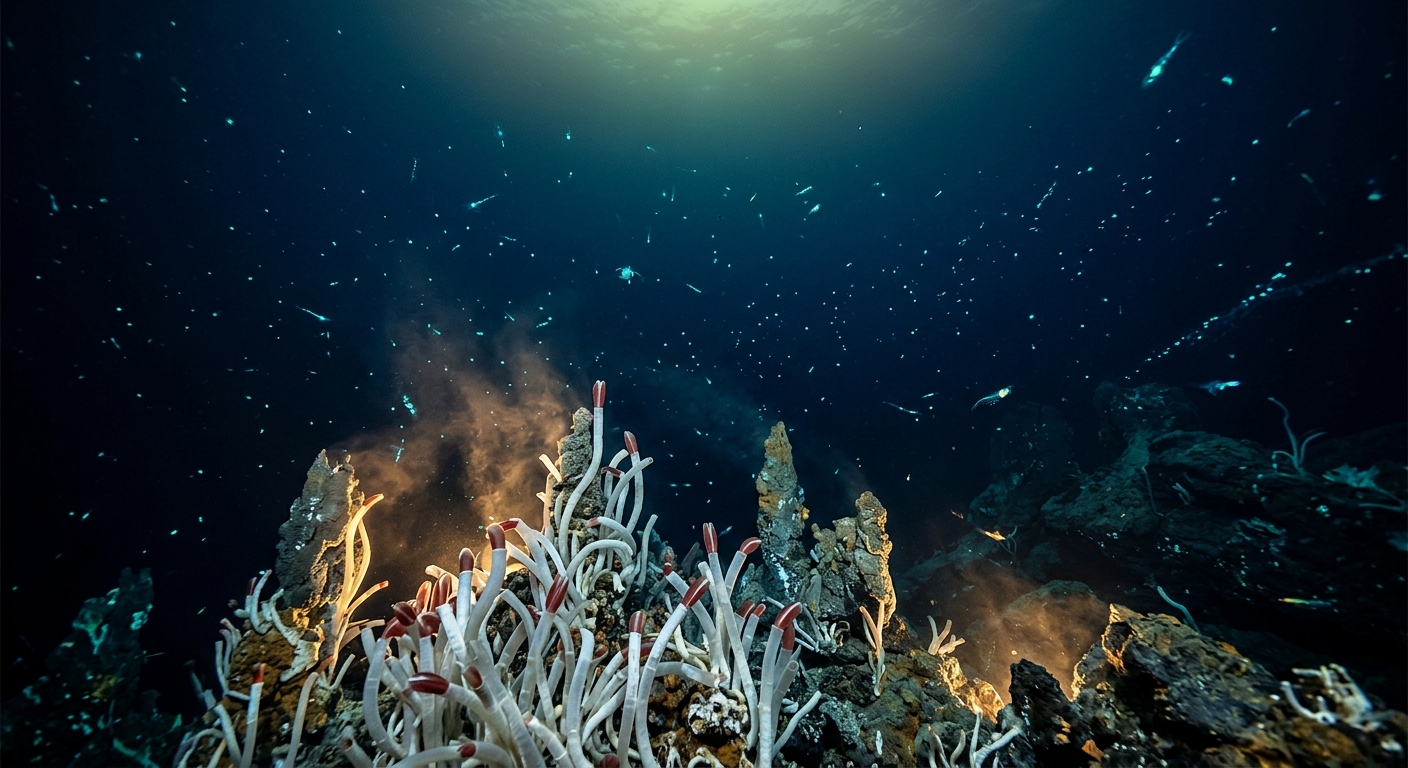
And what entries that ledger holds. Kilometers below where sunlight gives up, entire ecosystems thrive on chemical energy venting from the planet's crust—communities of tube worms and ghostly shrimp that never once needed the sun. How many of these deep-sea colonies exist? We genuinely do not know. Meanwhile, sailors keep documenting bioluminescence patterns that no model fully explains—wheels of rotating light and glowing waves stretching to the horizon.
Then there is the ocean's role as the planet's climate engine. Deep currents—slow, globe-spanning conveyor belts of water—regulate temperatures on every continent, yet the mechanics of how they shift remain full of gaps. Those gaps matter. Ice cores record abrupt climate swings in Earth's past: temperatures lurching several degrees within a single lifetime. Further back, the astonishing theory of "Snowball Earth" suggests the entire planet may have frozen over at least twice before somehow thawing through processes researchers are still debating.
All these unsolved mysteries—in the desert, in the deep, in the water—might make you wonder. With so much left to chart right here, why are we looking up at the stars at all?
Two Telescopes, One Expedition
The question is fair, but the answer might surprise you. These are not rival journeys. They are the same expedition, just with two telescopes pointed in different directions.
When scientists study Mars or peer into the cosmos with the James Webb Space Telescope, they aren't abandoning Earth; they are gathering field notes on other worlds to better understand our own. Think of Venus and Mars not as separate destinations, but as pages in our planet's biography, showing alternate endings. Venus helps us ask sharper questions about runaway climate. Mars offers clues about lost water and ancient geology. As one observer noted, looking outward gives scientists new ways to think about chemistry and weather—ideas that can circle back home and make Earth look newly strange, and newly legible, too The Overview.
That same instinct—the one that sends a rover crawling across a rust-red crater—is the one that should make us stare, delighted, at a pink lake or a giant stone bullseye. What is this place? How did it happen? What story is the landscape trying to tell?
Space is not a distraction from Earth. It is part of the same grand habit of attention. And if anything, looking outward should make us more eager to look down.
The Adventure Is Here
So after traveling across continents and through geologic time, where does our search for alien worlds truly begin? Perhaps it starts by realizing we're already on one.
For all our telescopes aimed at the stars, we walk every day on a planet of staggering, beautiful strangeness. This is a world with bubblegum-pink lakes that never fade, continents that surf on a sea of molten rock, and a stone bullseye carved into a desert by forces we're still struggling to name. We are the aliens here, explorers just waking up on a foreign shore we've mistaken for home.
You don't need a rocket ship for this mission. The greatest expedition is already underway, and your ticket is simply a moment of curiosity—a willingness to look at the familiar until it becomes fantastic again. The search for the unknown doesn't have to happen light-years away. It's waiting in the weird geometry of a seashell, the ancient silence of a canyon, or the impossible resilience of a weed growing through concrete.
This planet isn't finished showing us its secrets. Not even close. The adventure is right here, waiting to be rediscovered. So the next time you feel the pull of the cosmos, look down first. What story is the ground beneath your feet trying to tell?