
We Know Who Built the Pyramids. We Just Can't Prove How.
This angle reframes the pyramid mystery as fundamentally an archival problem, not an engineering one.
informative · 8 min read · April 2026
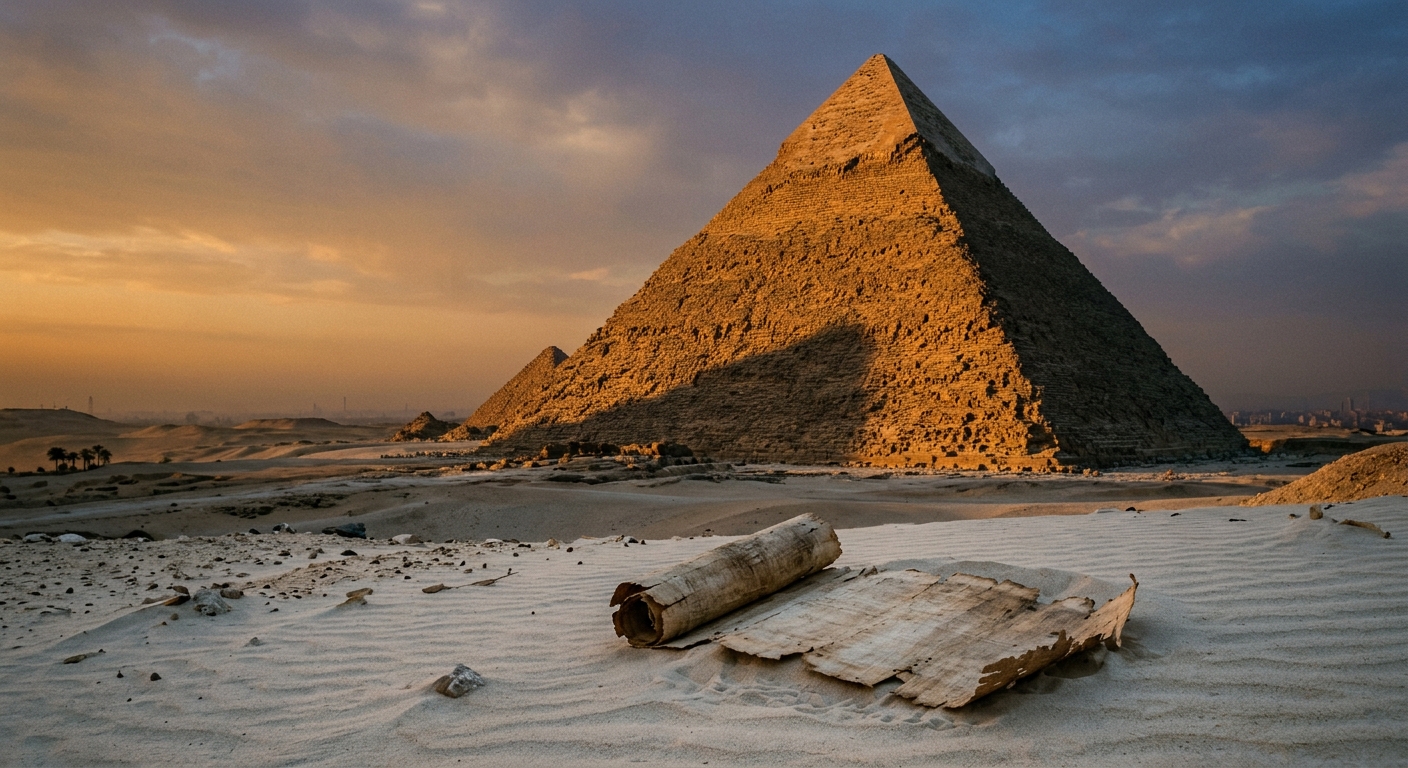
The enduring mystery of the pyramids has generated aliens, Atlantis, vanished super-civilizations, and a small industry of breathless documentaries. This isn't because the pyramids are inexplicable, but because they contain exactly the kind of gap people love to pour fantasy into.
The gap is specific. We are not staring at the Great Pyramid in total ignorance. We know it was built for the pharaoh Khufu, likely under the supervision of his vizier Hemienu. We know its original height was about 481 feet and that the project involved roughly two million stone blocks averaging 2.5 tons each, according to archaeological research Archaeology Magazine. This is not a mystery in the “nobody knows anything” sense. It is a mystery in the much more irritating sense: we know a lot, but not quite the one thing people most want spelled out.
What’s missing is the ancient walkthrough. No surviving Egyptian manual, blueprint, or step-by-step engineering account tells us exactly how every stage of construction worked, from quarry to final placement. Later writers offered hints—Herodotus mentioned “machines,” and Diodorus described mounds or ramps—but they were writing long after the fact and don't give us a clean answer. So even our strongest theories remain partly unverified.
This is the tension to keep in mind. This article won’t “solve” the pyramids. It will do something more useful: show you where the real mystery actually lives—and where it doesn’t.
What We Know for Sure
Let’s start with where the mystery doesn’t live: the foundational facts. Despite the documentaries promising lost secrets, the basics aren’t up for debate. The Great Pyramid was commissioned by Khufu around 2550 BCE and held the title of humanity’s tallest structure for nearly 3,800 years. None of this is speculation; it’s etched into the archaeological record.
This is precisely why we can retire the extraterrestrial or lost-technology theories with a polite dismissal. The actual marvel isn’t supernatural intervention; it’s administrative genius. Moving and placing that volume of material was a feat of state engineering, demanding a level of bureaucratic coordination that would still impress a modern logistics director. We don’t have Khufu’s original blueprints, but we don’t need them to recognize a sophisticated, highly managed operation. Decades of excavation at Giza have uncovered the physical receipts: purpose-built labor camps, administrative papyri tracking copper tool distribution, bakeries capable of sustaining thousands, and skeletal remains showing evidence of specialized medical care. This was a national project, sustained by seasonal labor and a tightly regulated supply chain.
We know the architects, the workforce, and the staggering scale. We’ve even experimentally confirmed how workers likely dragged multi-ton sledges across dampened sand to drastically cut friction NBC News. The honest answer, then, isn’t that we’re in the dark. We’re mostly in the light, squinting at the one piece of the puzzle that time erased: the exact vertical lifting system. And that missing detail is where the real debate begins.
The Transport Breakthrough
On the question of moving heavy stones across the ground, the evidence gets refreshingly solid. For this piece of the puzzle, we have a real, testable answer: wooden sleds on damp sand.
The physics is surprisingly elegant. Dry sand bunches up in front of a moving sled, meaning workers aren't just pulling the load; they're constantly shoving a small hill of sand out of the way. With the right amount of water, however, the sand grains form tiny “capillary bridges”—thin films of water that make the grains cling to one another. The result is firmer sand, less piling up, and significantly lower friction. In laboratory tests reported in 2014, researchers found that properly wet sand could cut the force needed to pull a load by about half, a result that neatly matches what archaeologists had long suspected from Egyptian imagery.
That imagery is key. A well-known tomb painting from the 12th Dynasty shows a colossal statue on a sled being hauled by a team of workers, while one figure at the front pours liquid onto the sand. For years, that detail was noted but not fully explained—perhaps it was ritual, perhaps practical. The mechanical explanation now gives it real weight. What looked like a minor artistic flourish turns out to be a sensible engineering adjustment you would expect from a society moving multi-ton loads regularly.
This is why the wet-sand finding is more than a clever anecdote. It’s one of the rare places where image, experiment, and practical logic line up perfectly. But this is also where our confidence should level off. Moving stone horizontally across the desert is not the same as raising it, course by course, into a 481-foot structure. Here, the evidence is firm. Beyond here, it starts to thin out fast.

The Lifting Problem
This is where the argument stops being comfortable. Getting blocks to Giza is one problem; getting them up a structure that would tower over the landscape is the part nobody can quite lock down.
The oldest and most intuitive answer is ramps. Perhaps a straight external ramp ran up one face, or a zigzag ramp climbed the outside, or a spiral wrapped around the pyramid as it grew. All are physically imaginable, but the trouble is scale. A straight ramp shallow enough to haul multi-ton blocks to the upper courses would have to be enormous—so enormous that, as many engineers have pointed out, it could require as much material as the pyramid itself. That doesn't make it impossible, but it makes it a logistical monster requiring more quarrying, more hauling, and the additional problem of removal.
To solve that, some researchers have proposed an internal ramp: a passage built within the pyramid’s outer shell, spiraling upward as construction advanced. It’s a clever theory because it reduces the need for a giant external earthwork. But the catch is simple: direct physical evidence is thin. The idea has attracted attention because it fits certain engineering constraints, not because archaeologists have found an unmistakable internal spiral with an explanatory inscription.
Then there are the lifting devices. Herodotus, writing two millennia after Khufu, said the pyramid was raised using “machines” to move stones from step to step. Diodorus of Sicily, writing later still, described construction with “mounds,” usually interpreted as ramps. Neither author was a contemporary witness, and they don’t even agree. The ancient sources matter, but as clues, not verdicts. Modern reconstructions of cranes and levering systems have their own problems, too. Once you ask what kind of timber, rope, and joinery could reliably handle the repeated stress, confidence starts to wobble. In these discussions, the word “possible” is doing a lot of work.
This is the honest state of things. Engineering analysis can narrow the field, telling us a method could have worked or that another becomes absurd at full scale. What it cannot do is prove which method the Egyptians actually used. On this question, possibility and proof are not the same thing.
The Archive Problem
That brings us to the real mystery—not aliens or lost super-machines, but the silence itself.
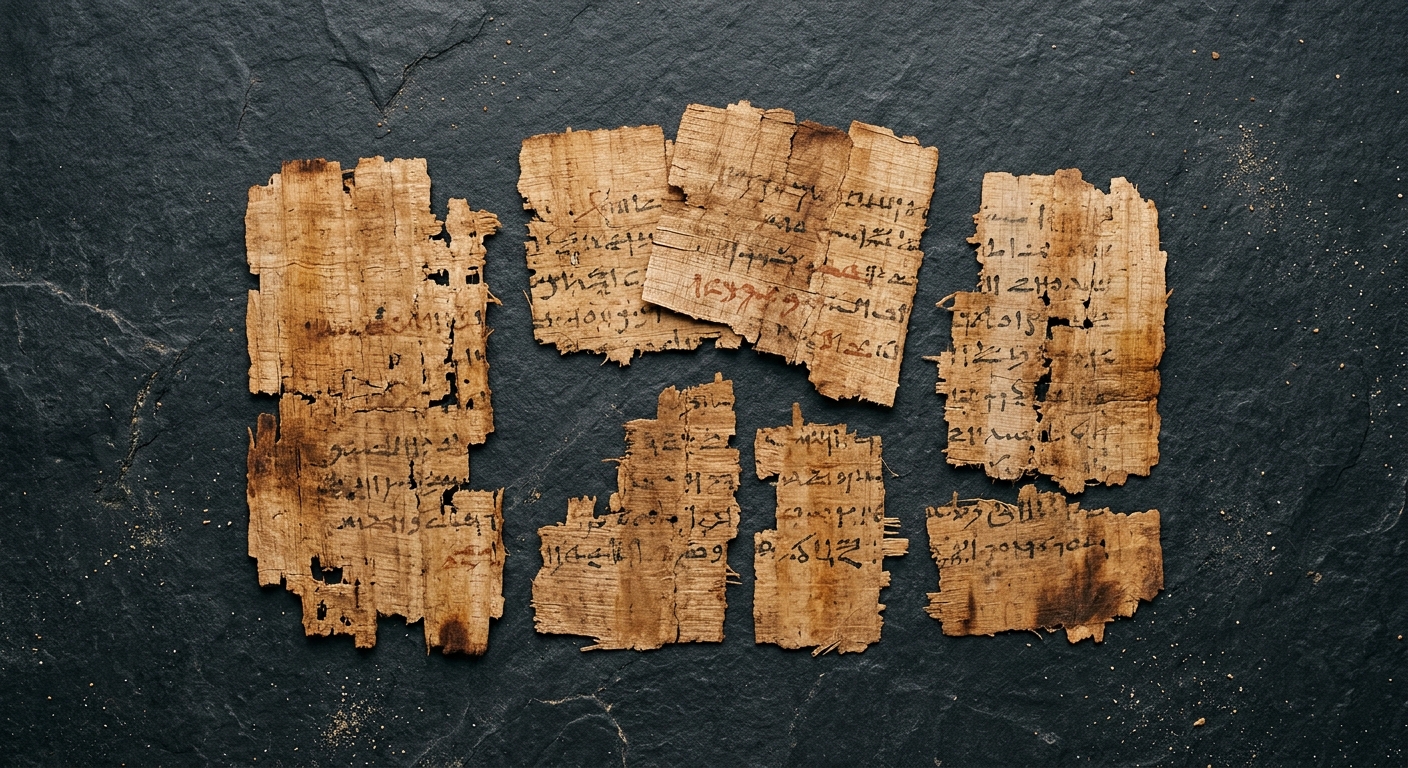
Ancient Egypt was not a civilization that forgot to write things down. It produced dense administrative paperwork, religious texts, tax records, and medical writing like the Edwin Smith Papyrus, which preserves surgical observations in striking detail Britannica. We have worker records from later periods, quarry inscriptions, and even documents from the pyramid age itself, like the Diary of Merer, a logbook recording limestone transport for Khufu’s project AERA. So when people ask, “Why don’t we have the pyramid instruction manual?” the question has real force. A culture this bureaucratic feels like it should have left one.
But the more likely explanation is simpler and harsher than a hidden archive: most records don't survive 4,500 years. Papyrus is fragile. Construction paperwork may have been kept on-site, used hard, and discarded. Some technical knowledge may have been restricted to master builders, or perhaps it wasn't written down in the way we expect because it was obvious to contemporaries working inside a living tradition. The construction sites themselves were temporary machines—ramps, haul roads, timber supports—built to be dismantled, reused, or left to erode.
There are things we haven’t found yet, and then there are things that almost certainly no longer exist. For pyramid construction records, the second category is probably the bigger one. The silence in the record isn't evidence of conspiracy. It’s a reminder that even one of the best-documented ancient civilizations still reaches us in fragments.
The Limits of Modern Technology
This is where modern technology helps most—while also showing exactly why the mystery persists.
Recent tools have genuinely changed the conversation. In 2017, the ScanPyramids project used muon tomography—tracking cosmic-ray particles passing through stone—to identify a previously unknown void inside the Great Pyramid Nature. Ground-penetrating radar can map subsurface features without tearing a site apart, and structural engineers can build detailed 3D models to test whether proposed construction sequences are mechanically plausible.
This is real progress. But notice what each method actually does. These tools can reveal what exists, model what could have worked, and test specific hypotheses. What they cannot do is recover an unwritten choice made by a construction supervisor 4,500 years ago: which ramp variant he preferred, how crews were organized on a particular day, or what workaround they used when a block jammed. If no direct record survives, no scanner can conjure it.
When the mystery persists, it isn't a failure of science. It is historical evidence behaving like historical evidence: incomplete, uneven, and occasionally maddening. Still, “incomplete” isn’t the same as “closed.” The discovery of the Wadi al-Jarf papyri—the oldest known, including Merer's diary—was a reminder that the archive can still surprise us Harvard University Press. We may never get a tidy instruction manual, but we are not done learning, either.
The Boundary of Knowledge
And that is probably the right place to stop: not with a dramatic reveal, but with a boundary line.
We can say with confidence that Khufu’s pyramid was a vast state project, built by human labor, with workable methods for quarrying and transport. The evidence for dragging heavy sleds over moistened sand is especially strong. What we cannot honestly do is pretend this settles the entire question. No surviving Egyptian manual tells us exactly how the full lifting system worked from base to apex.
That gap is not a license for fantasy. It is something more interesting: a reminder that history is built from what survives, and survival is uneven. Absence of evidence is not evidence of a conspiracy—but it is still an absence, and sometimes the missing piece really is just gone.
The mystery, properly understood, is not that the pyramids are impossible. It is that the stones are still here while the records explaining every move are not. That asymmetry is the story.